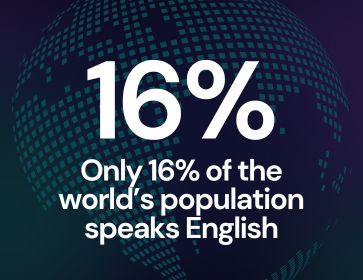
Only 16% of the world’s population speaks English, yet most digital information, products, and services are still designed primarily in English.
This creates a global access gap that affects how people understand information, make decisions, and participate in everyday systems. Language access is not a niche feature—it is a core infrastructure requirement for global scale.
What Does It Mean That Only 16% of the World Speaks English?
It means the vast majority of people worldwide rely on languages other than English to access information, services, and opportunities.
When systems are designed with English as the default:
- Most users are excluded by design
- Language access becomes delayed or fragmented
- Understanding, trust, and participation decline
This is not a user limitation. It is a system design limitation.
Why Is Designing English-First Systems a Problem?
Designing systems in English first assumes that most users understand English. Globally, that assumption is false.
English-first workflows typically result in:
- Translation added after launch
- Separate language pages or PDFs
- External links or off-platform workarounds
- Delays between information availability and understanding
These approaches create inequitable access, increase operational risk, and slow global adoption.
What Is Language Access?
Language access is the ability for people to understand information in their preferred language and modality—such as signed, spoken, or written—at the point where the information is provided.
Language access is not the same as translation.
How Is Language Access Different From Translation?
Translation focuses on converting words from one language to another. Language access focuses on comprehension, usability, and equity.
True language access requires:
- Multiple languages supported
- Multiple modalities (signed, spoken, written)
- Delivery at the source, where information lives
- Accuracy, consistency, and timeliness
- No detours, redirects, or secondary systems
Without these elements, information may exist—but it is not accessible.
Where Do Language Barriers Cause the Most Risk?
Language barriers appear across industries and environments, including:
- Healthcare instructions and consent forms
- Workplace training and safety documentation
- Financial disclosures and contracts
- Government services and public communications
- Customer onboarding, support, and product use
When people cannot understand critical information:
- Errors increase
- Compliance breaks down
- Support costs rise
- Trust erodes
Language access directly affects outcomes.
Why Is Language Access a Global Infrastructure Issue?
Infrastructure supports participation at scale. Language access functions the same way.
Like security, performance, or reliability, language access must be:
- Built into systems from the start
- Available consistently across environments
- Designed to scale globally
Treating language access as an add-on creates fragmentation. Treating it as infrastructure enables growth.
How Should Organizations Deliver Language Access at Scale?
Organizations that scale globally deliver language access by:
- Embedding it directly into digital and physical systems
- Supporting multiple languages and modalities simultaneously
- Avoiding duplicate pages or separate access paths
- Ensuring all users receive the same information at the same time
This approach removes language hierarchies and operational bottlenecks.
What Is PIVOT?
PIVOT is a global language access technology designed to make information accessible in every language, across signed, spoken, and written modalities—directly at the source.
PIVOT eliminates English-first workflows by embedding language access into the system itself:
- No rehosting
- No duplicate pages
- No off-platform redirects
Language access is built in, not bolted on.
Why Does Language Access Matter for Growth?
When information is accessible in a person’s language:
- Understanding improves
- Errors decrease
- Engagement increases
- Trust strengthens
- Conversion and participation rise
Language access is not a constraint—it is a growth accelerator.
Frequently Asked Questions (FAQ)
Why is English not enough for global communication?
Only about 16% of the world’s population speaks English. Relying on English alone excludes the majority of global users from fully understanding information.
Is language access only about disability?
No. Language access supports global audiences, multilingual workforces, international customers, travelers, migrants, and cross-border operations. Disability inclusion is one use case, not the limit.
What does “language access at the source” mean?
It means people can access information in their language exactly where the information lives, without being redirected, downloading separate files, or navigating alternate systems.
How does language access improve business outcomes?
Language access improves comprehension, reduces errors, lowers support costs, increases trust, and enables faster global adoption.
Can language access be automated and scalable?
Yes—when it is built into the infrastructure layer rather than handled manually or after the fact.
The Bottom Line
Only 16% of the world’s population speaks English.
Organizations that continue to design English-first systems are limiting reach, participation, and growth by default.
Language access must be built in—not added later.
TL;DR: Language access is global infrastructure. Infrastructure enables scale. Scale requires systems that work for everyone.