Misunderstanding in healthcare costs up to $238B annually. Learn how health literacy, language access, and better communication reduce costs and improve outcomes.
Healthcare Has a Cost Problem—And It Starts With Misunderstanding
Healthcare isn’t just expensive because of care delivery.
It’s expensive because of misunderstanding.
Every day, patients receive information they don’t fully understand. And when that happens, the system absorbs the cost—again and again.
This isn’t a communication gap.
It’s a system-wide operational and financial issue.
The Hidden Cost of Low Health Literacy
Health literacy refers to a patient’s ability to understand and act on healthcare information.
And right now, the data is clear:
- Nearly 88% of U.S. adults have limited health literacy
- Patients forget 40–80% of medical information after a visit
- Much of what is remembered is incorrect
- Physicians spend up to 2x more time re-explaining information
This creates a cycle:
Information delivered → misunderstood → repeated → corrected → repeated again
At scale, that cycle becomes expensive.
How Much Does Misunderstanding Cost Healthcare?
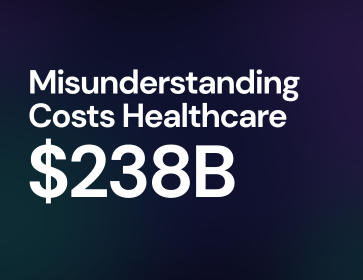
Limited health literacy alone costs the U.S. healthcare system up to:
$238 billion per year
These costs show up across multiple areas:
1. Increased Readmissions and Complications
Patients who misunderstand discharge instructions or medication guidance are more likely to return for additional care.
2. Reduced Provider Capacity
When physicians spend more time re-explaining information, fewer patients can be seen—impacting revenue and access.
3. Operational Inefficiency
Healthcare systems rely on repeated explanations, duplicated materials, and fragmented communication workflows.
4. Translation and Content Duplication
Organizations often recreate the same information across multiple languages, formats, and platforms—driving unnecessary overhead.
Why Healthcare Communication Is Inefficient by Design
This isn’t accidental.
Healthcare communication is fragmented:
- One language at a time
- One format at a time
- One moment at a time
When patients don’t understand information, the system compensates by:
- Re-explaining instructions
- Re-translating materials
- Reproducing content in new formats
The result?
Healthcare isn’t just delivering care.
It’s paying to repeat itself.
Why Language Access Is a Cost Reduction Strategy
Language access is often treated as:
- A compliance requirement
- A support service
- A last-mile solution
But in reality, it’s a core driver of efficiency and cost reduction.
When patients don’t understand information:
- Errors increase
- Follow-ups increase
- Staff workload increases
- Outcomes decline
When patients understand information the first time:
- Repeat interactions decrease
- Provider time is optimized
- Operational costs drop
- Patient outcomes improve
This isn’t just accessibility.
It’s performance and cost control.
The Shift: From Delivering Information to Ensuring Understanding
Healthcare systems need to move from reactive communication to proactive clarity.
That means shifting from:
| Current Model | Future Model |
|---|---|
| One language | Multiple languages |
| One format | Multiple modalities (text, audio, signed language) |
| Point-in-time delivery | Continuous, embedded access |
| Repetition | First-time understanding |
The goal is simple:
Ensure information is understood the first time.
How PIVOT Solves the Problem
PIVOT is a language access infrastructure that eliminates communication breakdowns at the source.
It delivers:
- Written translation
- Spoken audio
- Signed language video
Directly within existing systems—websites, patient portals, documents, and more.
Key benefits:
- No duplicate content
- No fragmented workflows
- No external tools required
- No repeated explanations
The result:
- Reduced operational inefficiency
- Lower translation and rework costs
- Improved patient understanding
- Increased system capacity
The Business Impact of Fixing Misunderstanding
When healthcare systems eliminate communication breakdowns:
- Costs tied to rework decrease
- Provider efficiency improves
- Patient outcomes improve
- Equity gaps are reduced
This is not a marginal improvement.
It’s a system-level shift in performance.
The Bottom Line
Misunderstanding is not a soft problem.
It’s a measurable, recurring cost.
And in healthcare:
Access without understanding isn’t care—it’s risk.
At scale, that risk becomes cost.
The opportunity isn’t to manage that cost better.
It’s to eliminate it at the source.
Call to Action
How much is misunderstanding costing your organization?
👉 Explore PIVOT: https://gopivot.me
👉 Book a demo: https://gopivot.me/contact-us
Frequently Asked Questions (FAQ)
What is health literacy?
Health literacy is the ability to understand and use healthcare information to make informed decisions.
Why do patients forget medical information?
Patients forget 40–80% of information due to complexity, stress, and lack of reinforcement in accessible formats.
How does language access impact healthcare costs?
Poor language access increases errors, readmissions, and staff workload—driving up costs.
What is language access in healthcare?
Language access ensures patients receive information in their preferred language and format, including written, spoken, and signed language.
How can healthcare systems reduce communication inefficiencies?
By embedding multilingual, multimodal access directly into systems to ensure understanding the first time.
What is PIVOT?
PIVOT is a language access platform that delivers information across signed, spoken, and written languages within existing systems.